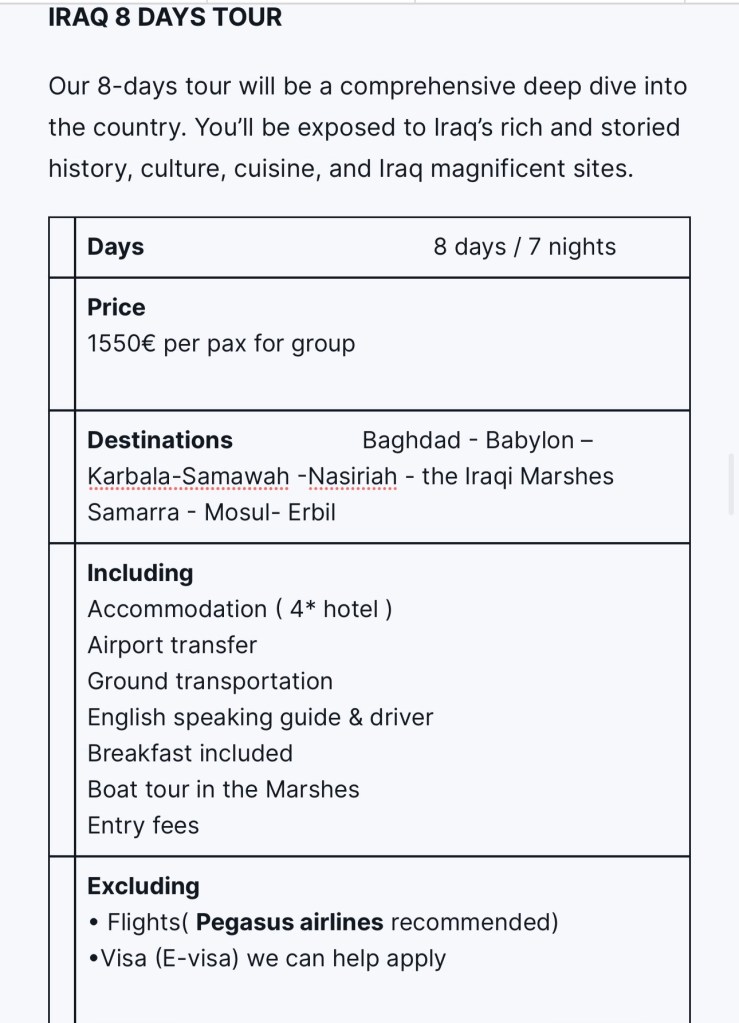
Our 8-days tour will be a comprehensive deep dive into the country. You’ll be exposed to Iraq’s rich and storied history, culture, cuisine, and Iraq magnificent sites.
*First Day
Baghdad
Arrive at your convenience into Baghdad – the capital city of Iraq a day before the tour starts to . ◦ Transfer to Hotel using registered Airport taxis whose waiting for you at the airport
Baghdad day trip Passing Tahrir Square which translates to Liberation Square – it’s Baghdad’s largest and most central square which commemorates the 1958 establishment of the Republic of Iraq. Then heading to National Museum.
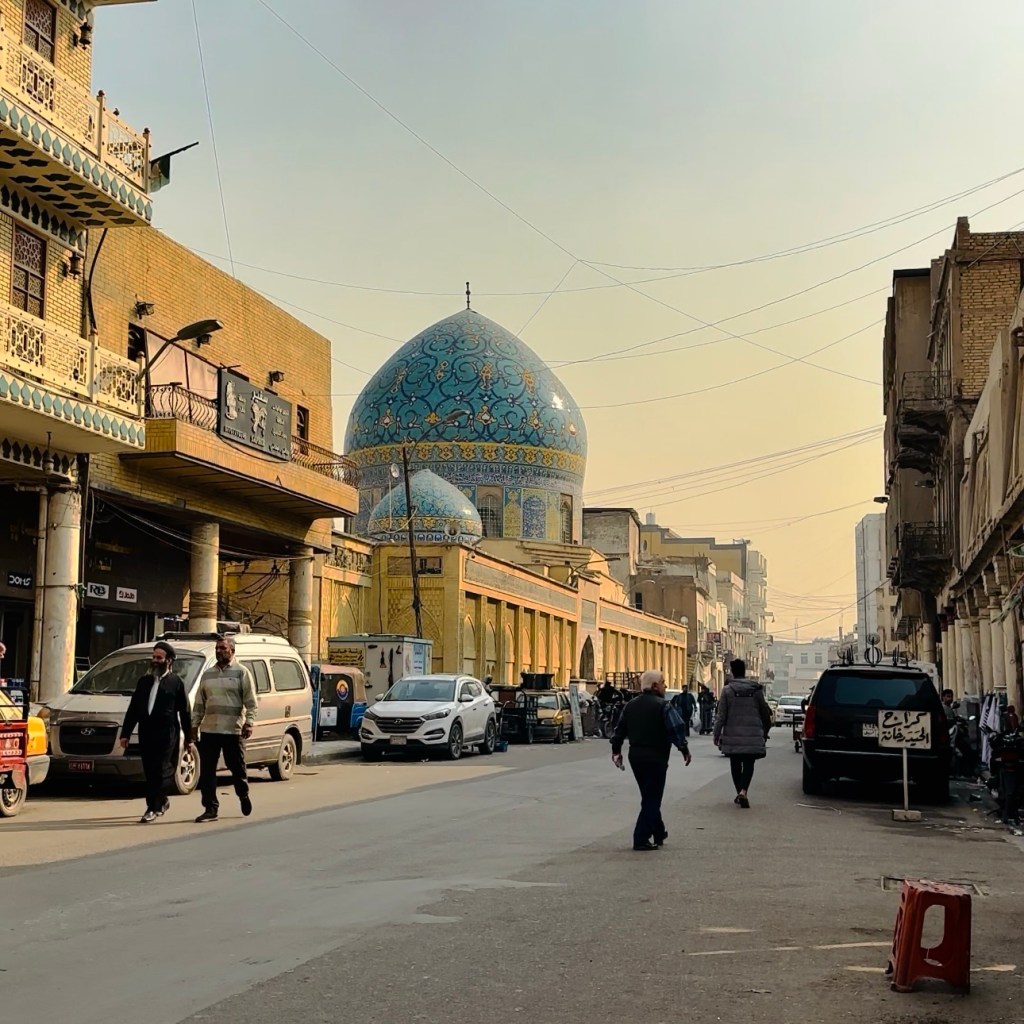
Al-Mustansariya School, this used to be the most important university in the Islamic world. Almutanabi Street, also known as Book Street.
Copper market and Al shaheed monument Martyrs monument
going at night to the modern part of Baghdad to get a SIM card for the interested travellers
Lunch break in town to try local popular Iraqi dishes such as Kubba and Mandi in Darbona restaurant • Highlight: Al Shaheed Monument, an imposing structure commemorating the first Gulf War.

National Museum of Iraq
the National Museum of Iraq, which established 100 years ago & due to the archaeological riches of Mesopotamia, the museum’s collections are considered to be among the most important in the world specifically the ones from URUK which are considered to be the first urban city in history dating to 5500BC Eridu period & as the Mesopotamian history consider to be a cradle of civilization.
Martyr’s Monument
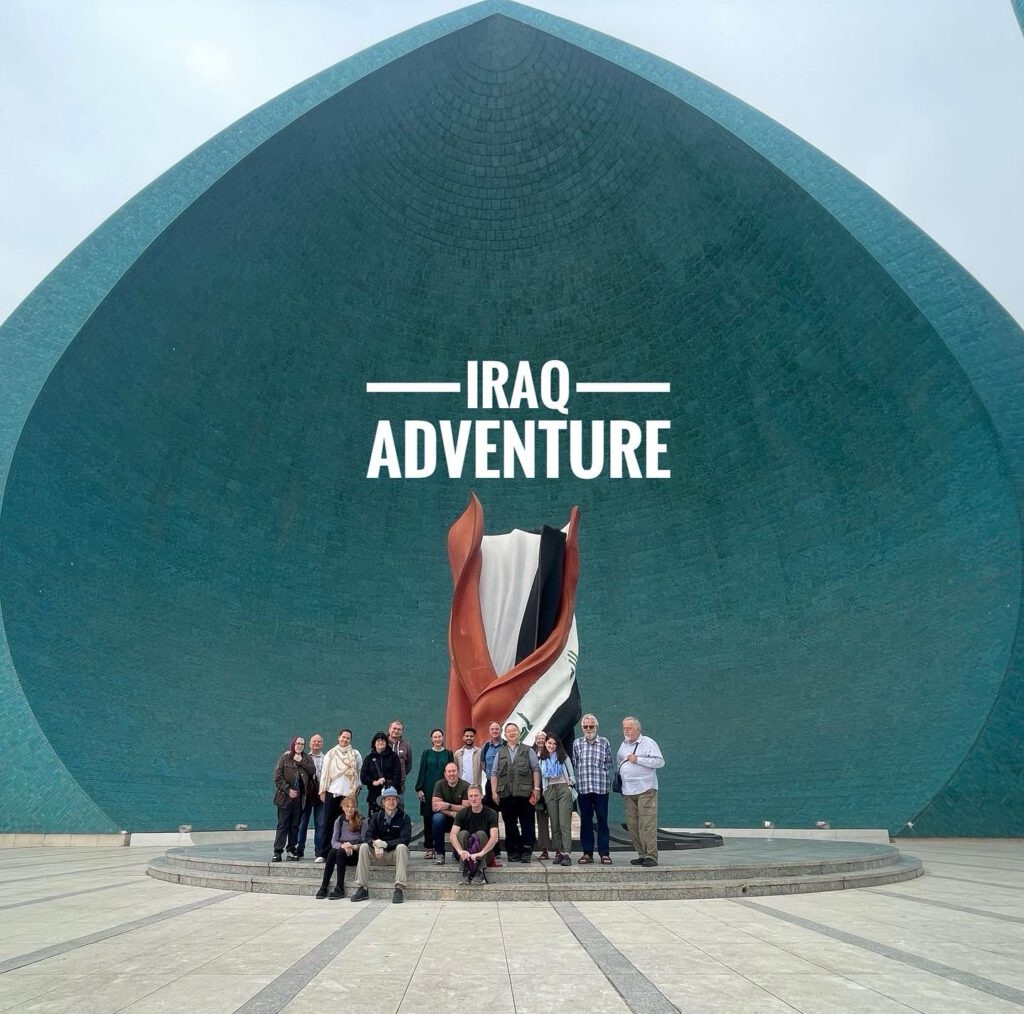
Al-Shaheed Monument also known as the Martyr’s Memorial is a monument designed by Iraqi Sculptor Ismail Fatah Al-Turk, located in Iraq capital, Baghdad.
The monument dedicated to the Iraqi soldiers who died in Iran-Iraq War. The two halves of the split turquoise dome are offset with an eternal flame in the middle.
It is one of the most iconic monuments in Iraq.
*2nd Day
Babylon – Karbalala
Travel from Baghdad to Karbala. On the route visit the remains of the city of Babylon, . At Babylon we will also visit an old palace of Saddam’s.
we will visit the legendary city of Babylon. It is still impresive to walk the same streets that the rulers of one of the most prominent ancient empires once did and where Alexander the Great died.
The city prospered under the reign of no Nebuchadrezzar II – one of the most powerful monarchs of the Neo- Babylonian Empire.
In the 20th century, Saddam Hussein, who saw himself as a modern reincarnation of Nebuchadnezzar, sponsored a reconstruction of the city.
The construction was rather modern and didn’t take into consideration the actual ruins and was thus derided by the archelogical world.
We will get the chance to walk through a reconstruction of the glorious Ishtar Gate – constructed of vibrant blue tiles and adorned with depictions of fantastic animals. We will then proceed to the Karbala – a holy city for the Shia Muslims.
It’s the place of one of the largest religious gatherings in the world. Every year hundreds of thousand of Shia Muslims come here to mark the holy day of Ashura and commemorate the martyrdom in battle of the Imam Hussein, a grandson of the Prophet Muhammad, in 680AD. Overnight in a hotel in Karbala.
Karbala
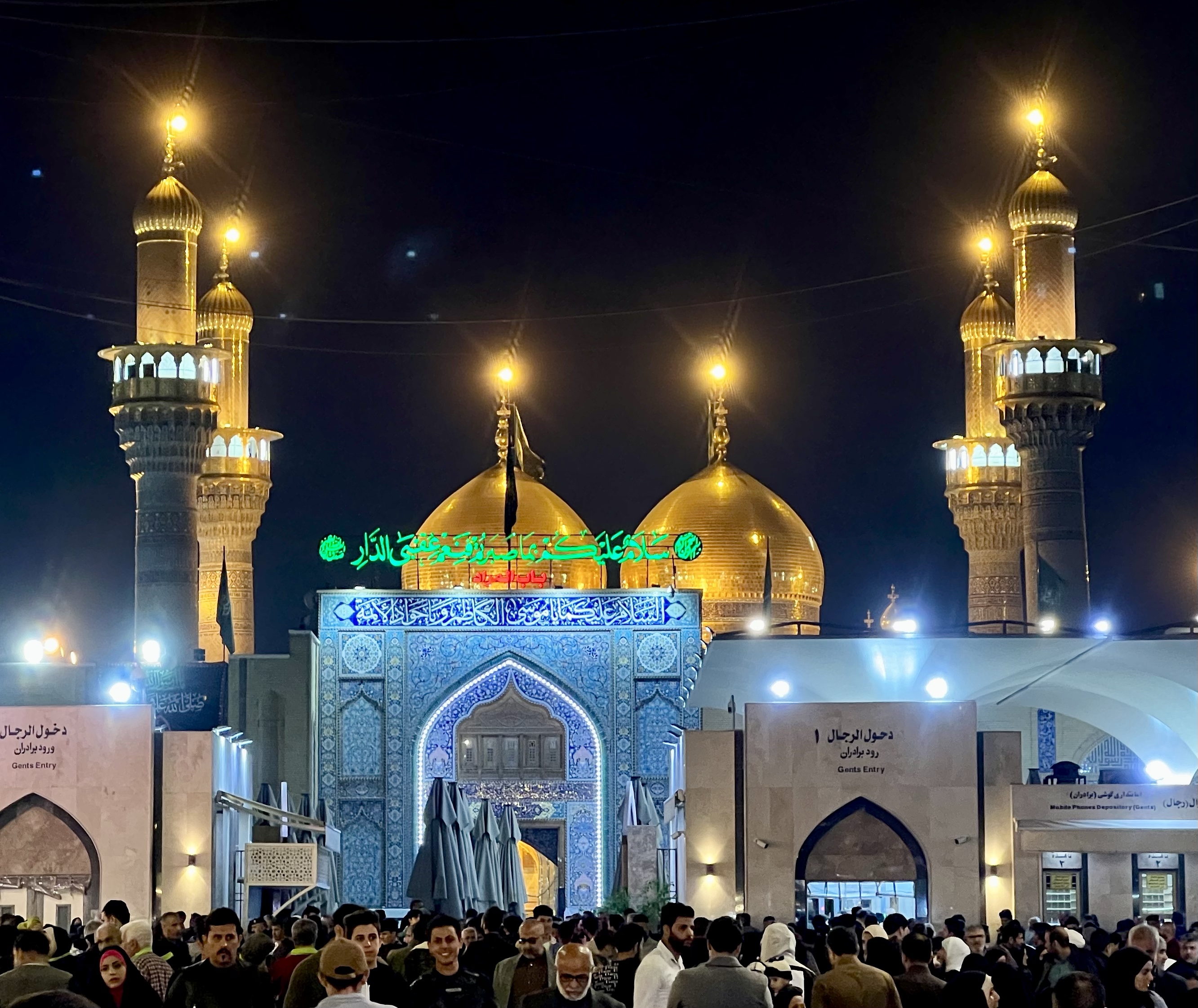
It’s the place of one of the largest religious gatherings in the world. Every year hundreds of thousand of Shia Muslims come here to mark the holy day of Ashura and commemorate the martyrdom in battle of the Imam Hussein, a grandson of the Prophet Muhammad, in 680AD. Overnight in a hotel in Karbala.
Babylon
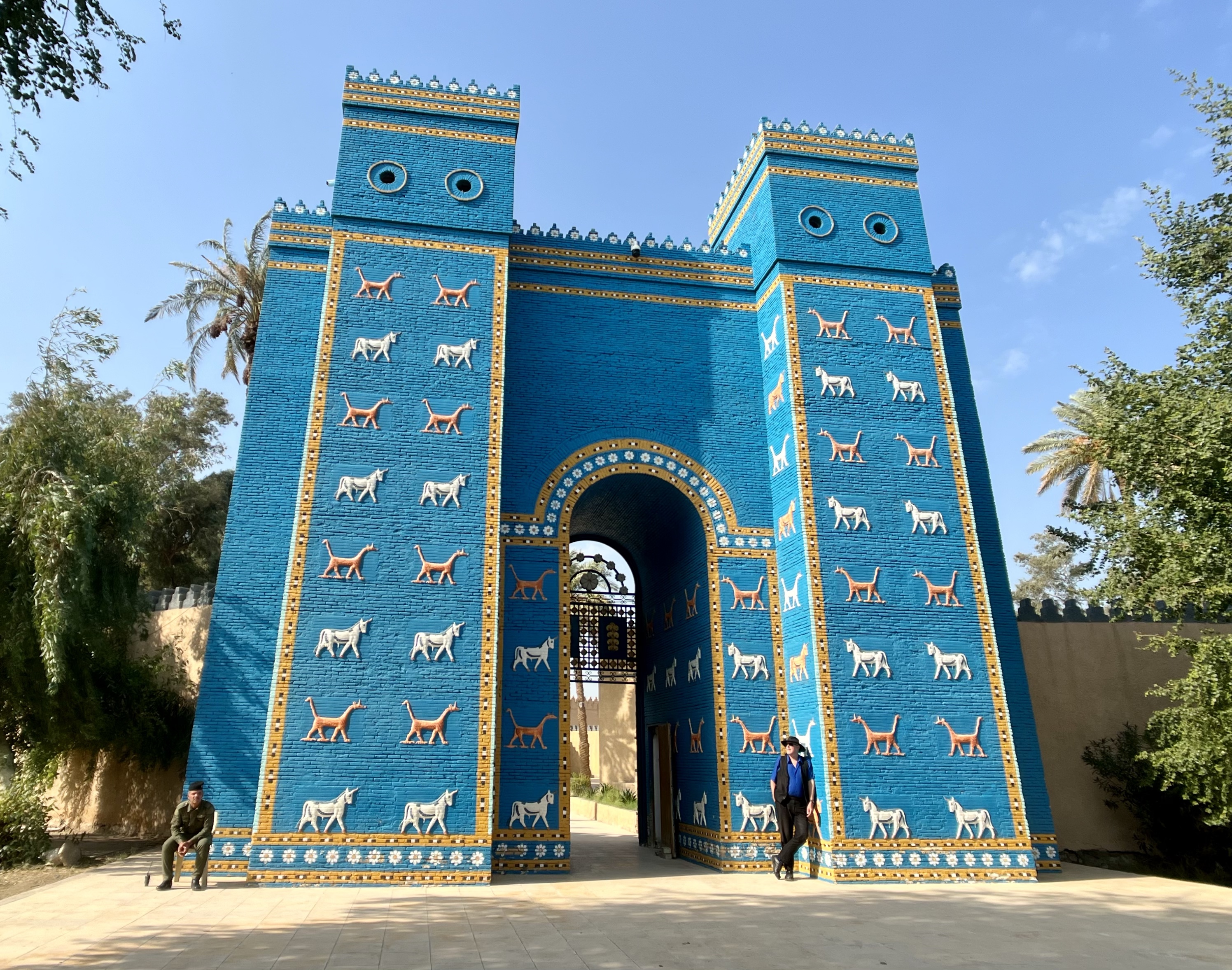
The Ancient City of Babylon currently Iraq was a metropolis and main Kingdom in the Mesopotamia region and the largest city at some point reaching 200,000 people. Originally built as a small town in 2300 BC, Babylon was a powerful city-state between 18th-6th century BC. In the picture, I am standing in front of the entrance to Babylon, the Ishtar Gate. Ishtar is the Babylonian goddess of fertility, love, and war.
One of the Seven Wonders of the Ancient World is believed to have been here, The Hanging Gardens of Babylon. The Gardens of Babylon were built for Queen Amytis by her Neo-Babylonian King Husband because she missed the rolling green hills of her homeland another significant event was the death of Alexander the Great. Alexander was the King of the Macedon empire.
*3rd Day
URUK & Marshes
Today we will visit the ancient city of URUK
one of the most important. cities one time, the most important ancient mesopotamian city to the Sumerians. it was founded by King Enmerkar c. 4500 BCE. Uruk is best known as the birthplace of writing c. 3200 BCE as first written language cuneiform writing. Located in the southern region of Mesopotamia(modern day Warka, Iraq), Uruk was known in the Aramaic language as Erech which, it is believed, gave rise to the modern name for the country of Iraq, though another likely derivation is Al-Iraq, the Arabic name for the region of Babylonia. The city of Uruk is most famous for its great king Gilgamesh and the epic tale of his quest for immortality but also for a number of firsts in the development of civilization which occurred there.
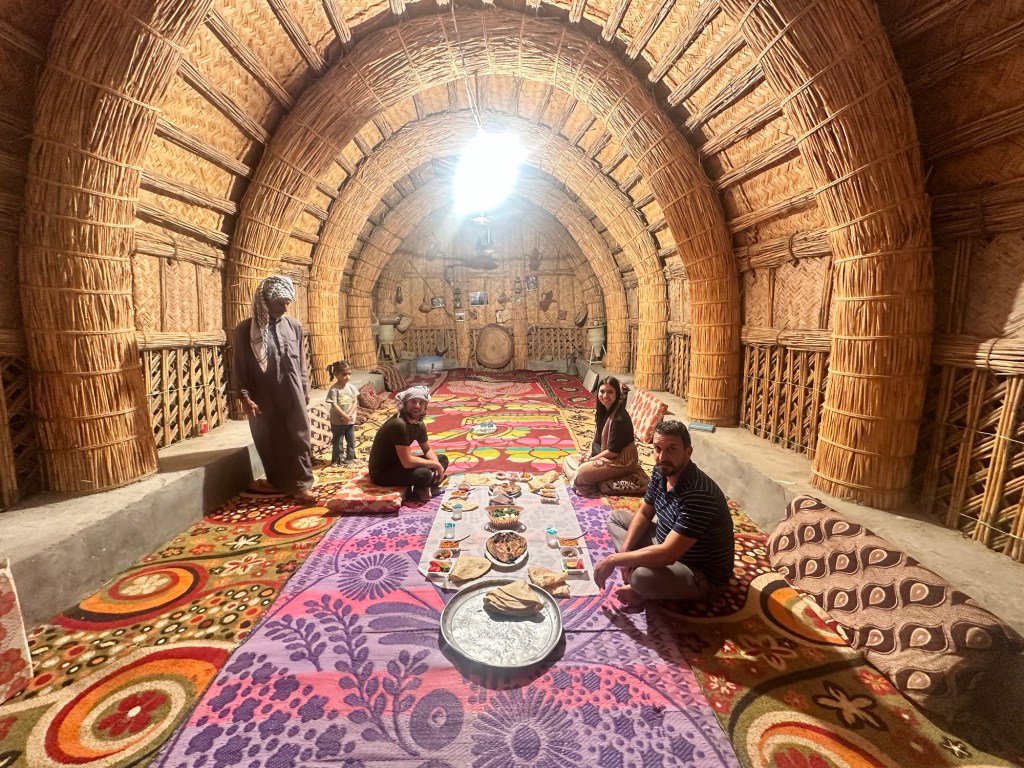
Then we will head to the Mesopotamian marshes for an over night in the local house with spending the night with local family * prepare one night essentials cause if it’s a big group its better to keep things at the Bus & bring your own towel for this night.

*4th Day
Marshes sunrise & UR Ziqqurat
Today we will wake up at 4:30 AM to see the sunrise along the Marshes – one of the largest wetland ecosystems in the Middle East and explore their incredible wildlife. We will get to learn more about the Ma’dan people, also known as Marsh Arabs – who have lived on those wetlands for thousands of years and have managed to sustain their traditional lifestyle to present days. Their lifestyle and culture was centered on their natural surrounding: a great example of that are the traditional reed houses, built from the reed growing in the water landscape and then heading to UR ziqqurat
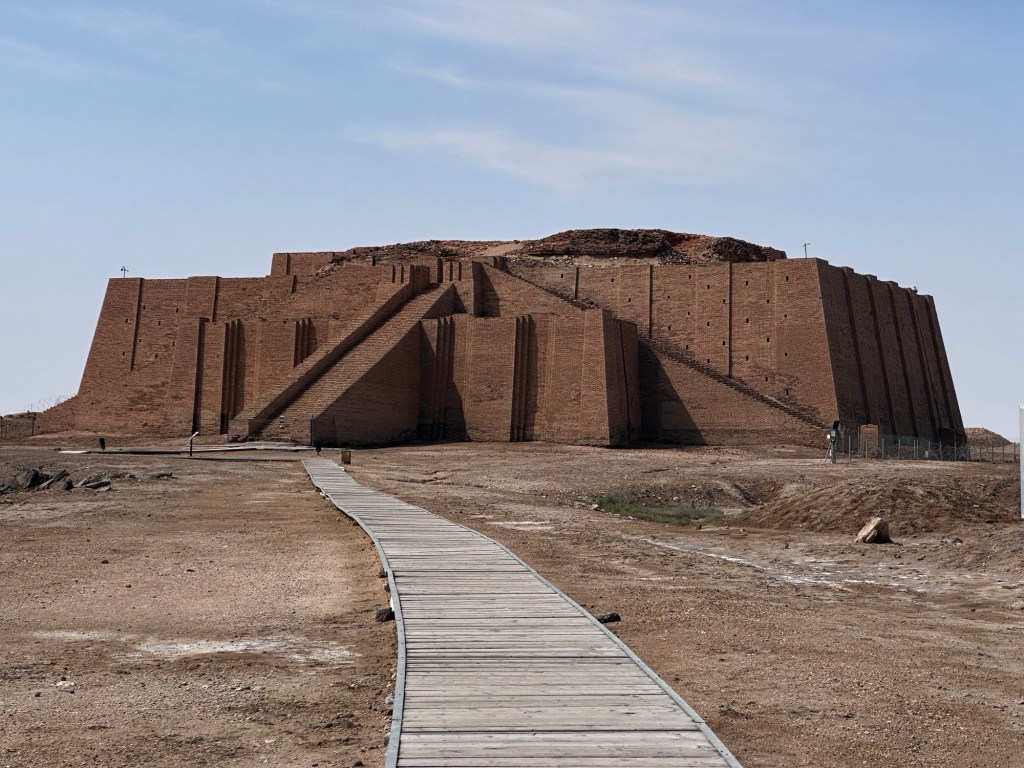
Ur – a Sumerian city-state built in 3800 B.C. Nassriah also believed to be the biblical “Ur of the Chaldees” – the birthplace of Abraham. We will tour the famous Ziggurat of Ur – a stone temple complex built in honour of the moon God Nanna, the patron deity of the city. In the afternoon we will go back to Bagdad Overnigh in the hotel.

*5th Day
Samarra – Hatra – Mosul
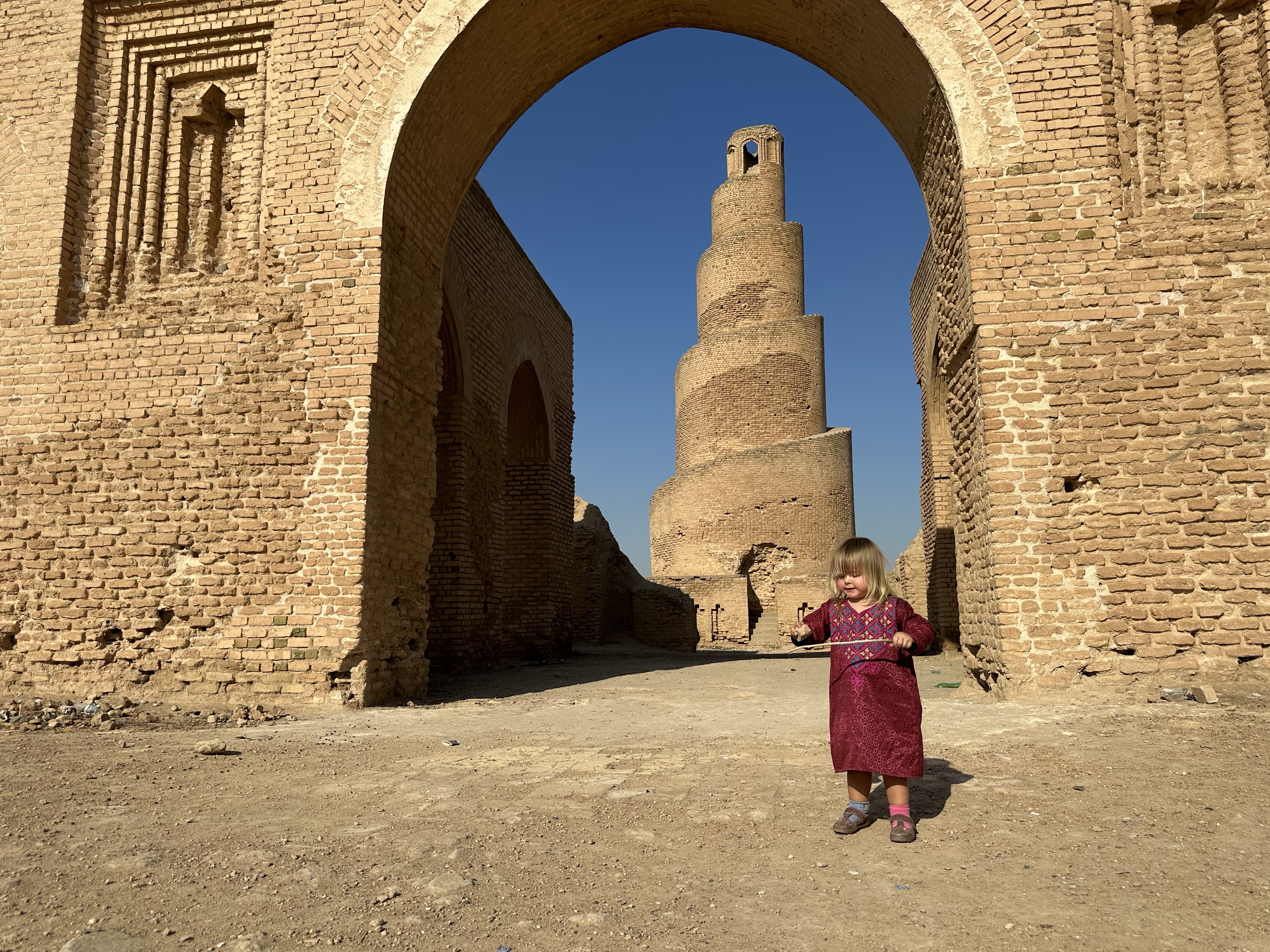
Day trip to Samarra to visit the Great Mosque of Samarra with its spiral minaret which is consider archeological site, a UNESCO world heritage site and largest mosque at the world during its period . then head to the Virgin palace with its huge pool in the middle then to Medieval Times prison then complete our journey to Mosul to visit the heritage centre of Mosul to find out more about the history of the city
The Great Mosque of Samara
The Great Mosque of Samarra was the world’s largest mosque when it was built and dates back to the 9th century located in Samarra, Iraq. The mosque was completed in 851 by the Abbasid caliph Al-Mutawakkil. At the time of construction,. It is known for its 52-meter (171 ft) high minaret encircled by a spiral ramp, the Malwiya Tower. The mosque is Archaeological City UNESCO World Heritage Site, listed in 2007. The structure is composed of a large rectangle of almost 38,000 square meters with the 3:2 proportions typical of many mosques.
*6th Day
Mosul Lalish – Erbil
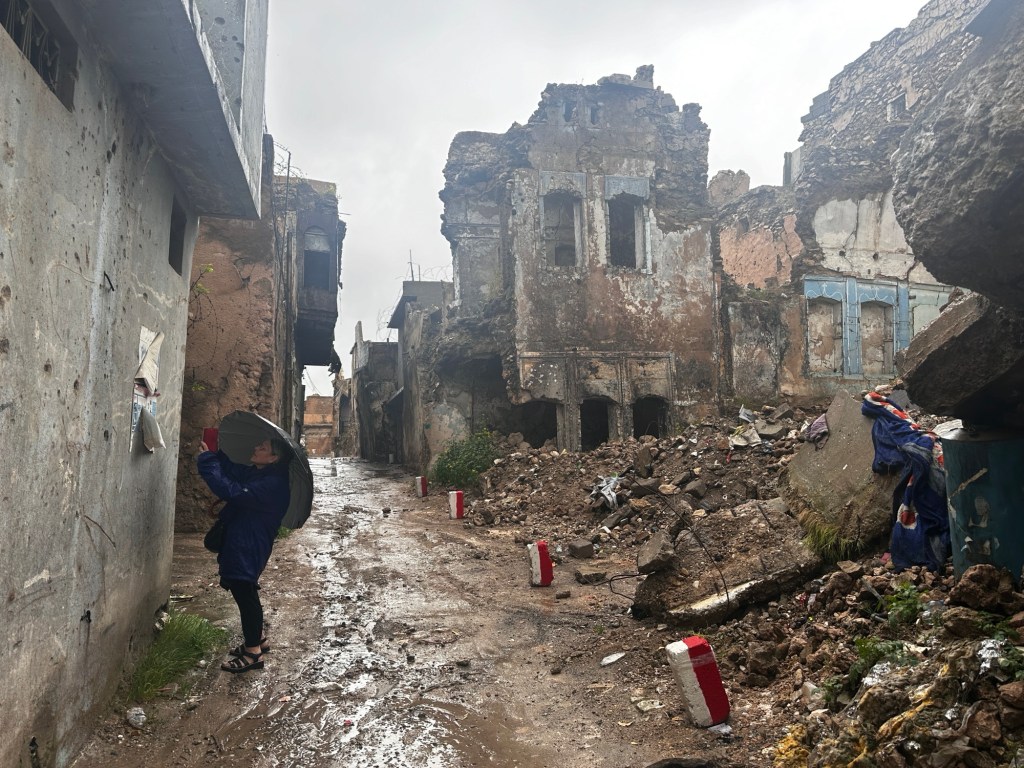
Visiting the Destroyed old side of Mosul 5 years after the libration of Mosul which was like letting go bird out of the cage to freedom it was by the Iraqi Army in cooperation with coalition forces while a huge rebuilding is happening, the destruction still can be seen on the old side of Mosul. And visiting the Assyrian wall gates
Then heading to Soque which is the main market in the city.
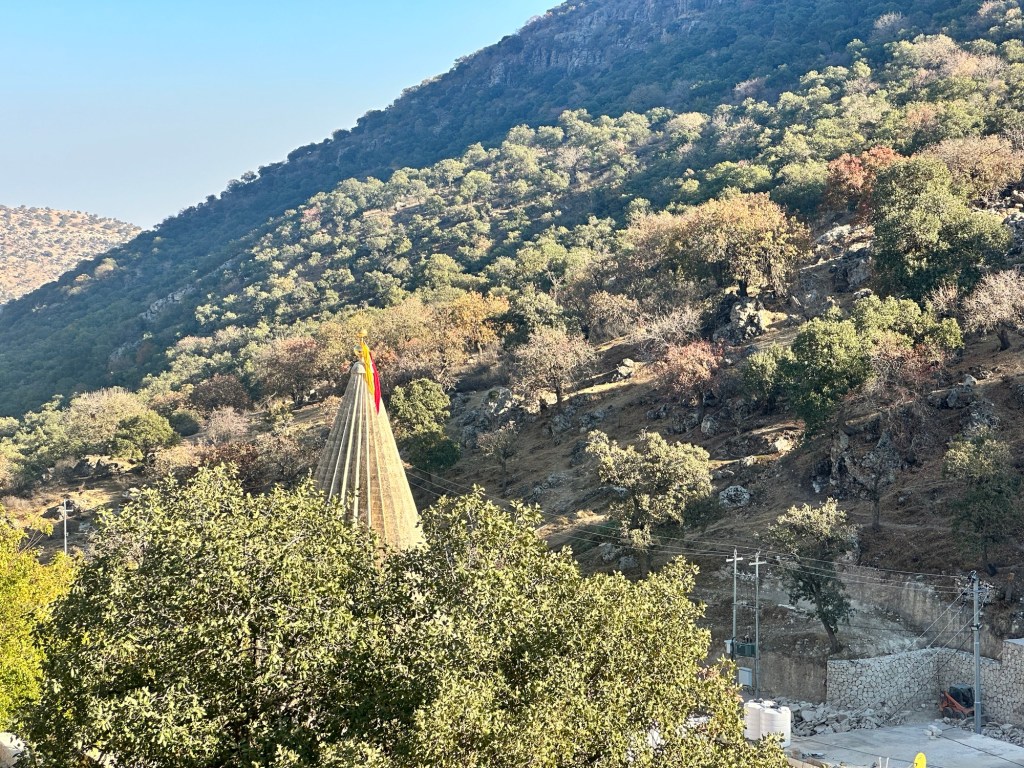
Visiting Lalish (Arabic: لالش, is a mountain valley and temple in Shekhan in Iraq. It is the holiest temple of the Yazidis which is a monotheistic faith based on belief in one God
The village is not inhabited, only the head figure in the Yazidi faith, the Emir, lives here. There are many empty houses in the village, which are available to pilgrims that are expected once in their life to make a six day pilgrimage to the temple. On the way to Lalish we will visit a Christian town in the Nineveh Plains of northern Iraq, a sub-district of the Tel Kaif District situated 45 km north of the city of Mosul to see the ancient part of the city.⠀then heading to Erbil for over night
*7th Day
Erbil
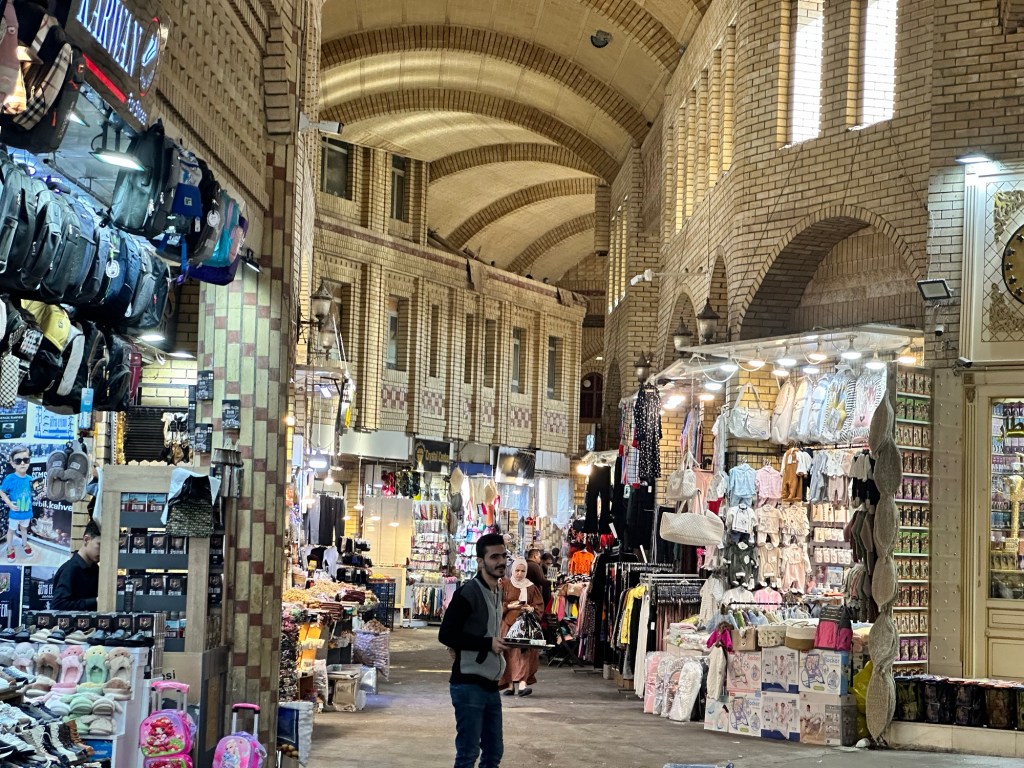
Visiting the main square of Erbil which is full of life, super kind and friendly local people then heading to The Erbil Citadel, which is also called Qelat, is a UNESCO Worl Heritage Site since 2014. The exact time of building the citadel is unknown. But it was probably built in the final stage of the Stone Age, in the Neolithic period, which ended in 4500 BC. Qaysari Bazaar is the covered bazaar in the old center of Erbil just next to the main square.
Heading to Jalil Khayat Mosque a very beautiful mosque about 2 km from the Citadel of Erbil. It was being built between 2005 and 2007. On the way heading to Qalay Deren. And at night we can head to Askan street & then an overnight in Erbil .
8th Day
Departure
More recommended to book departure from Erbil airport
 IRAQ ADVENTURE